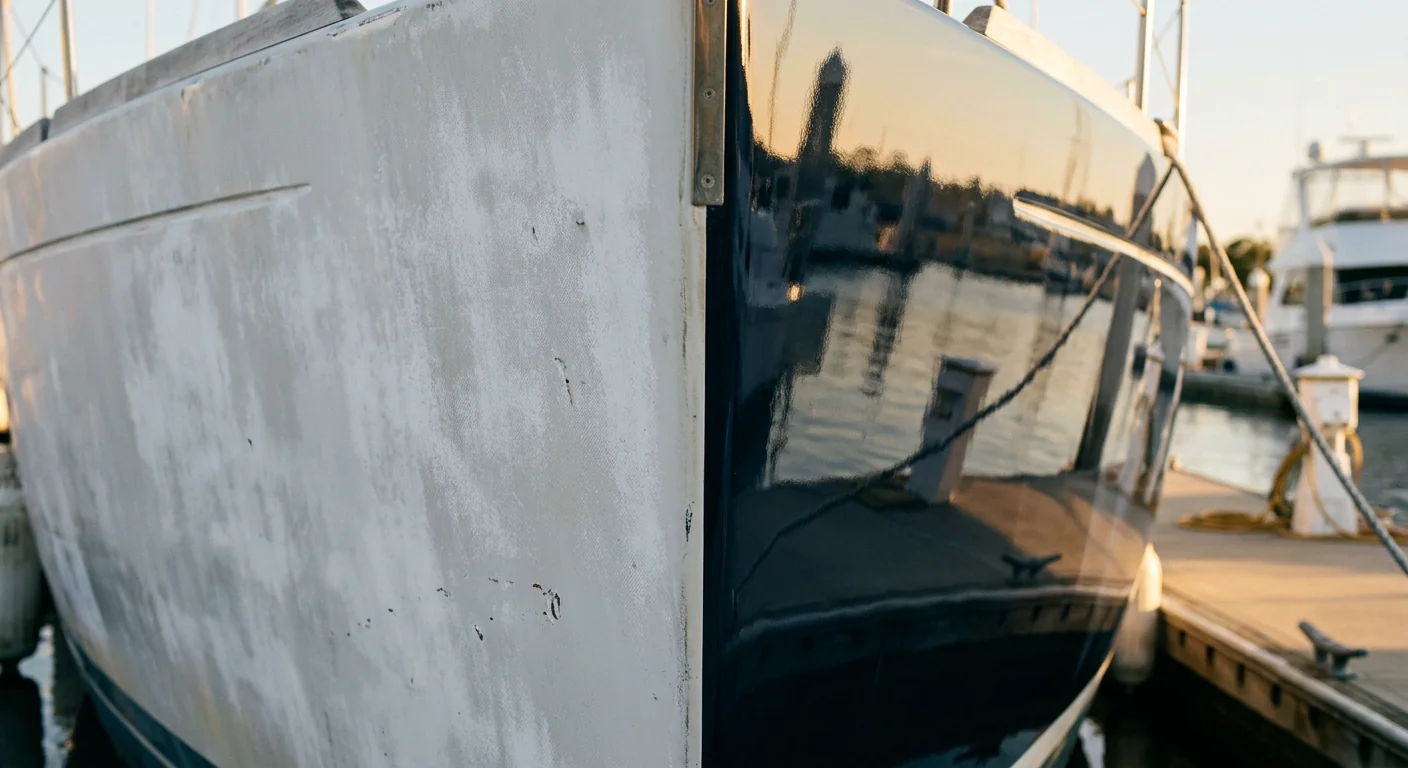
Why Boats Oxidize Faster in South Florida
Gelcoat is the protective outer layer on your boat's fiberglass hull. It is designed to be durable, but it is not permanent. UV radiation breaks down the resin in gelcoat over time, causing it to lose its gloss, turn chalky, and eventually expose the raw fiberglass underneath.
In South Florida, this process happens significantly faster than the national average. Miami's UV index reaches 12 to 13, classified as "Extreme," for roughly half the year. That is the equivalent of unfiltered midday tropical sun hitting your hull every day from April through September. Add constant saltwater exposure and humidity above 70%, and you have the perfect conditions for accelerated oxidation.
A boat in the Northeast might go 2 to 3 years before showing visible oxidation. In South Florida, an unprotected hull can begin chalking in as little as 6 months.
Our Oxidation Removal Process
Oxidation removal is not a simple buff. It is a multi-stage correction process that removes the damaged layer of gelcoat to reveal the undamaged material underneath.
- Marine wash and rinse: Removes salt, dirt, and loose contaminants so we can assess the true condition of the gelcoat
- Clay bar decontamination: Pulls embedded contaminants (dock runoff, mineral deposits, industrial fallout) from the surface
- Oxidation assessment: We grade the severity from light (surface haze) to heavy (deep chalking with no reflectivity) to determine the number of correction stages needed
- Heavy compound cut: For moderate to severe oxidation. A cutting compound paired with a wool or microfiber pad removes the damaged gelcoat layer
- Medium polish: Refines the surface after cutting, removing compound marks and beginning to restore clarity
- Finishing polish: Produces the final high-gloss, swirl-free finish. This is where the "wet look" comes back
- Protection application: We seal the corrected gelcoat with ceramic coating or marine-grade wax to prevent re-oxidation
Before and After: What to Expect
Light oxidation responds quickly. One to two correction stages typically restore full gloss. The hull goes from hazy and dull to reflective in a single session.
Heavy oxidation requires more work but is still reversible in most cases. Three correction stages can take a hull from completely chalked and faded to a finish that looks close to factory new. The key is addressing oxidation before it penetrates so deep that the gelcoat becomes too thin to correct safely.
Prevent Oxidation From Coming Back
Correcting oxidation without protecting the surface afterward is wasted effort. The freshly exposed gelcoat is more vulnerable than ever. We always recommend one of these options after correction:
- Ceramic coating: 2 to 3 years of UV and salt protection with a single application
- Marine wax: 4 to 8 weeks of protection per application, suitable for boats on a regular maintenance schedule
- Covered storage or boat lift: Reducing direct sun exposure slows oxidation regardless of what product is on the surface
Where We Work
We perform oxidation removal at marina slips, private docks, and driveways across South Florida. Common locations include Miami, Fort Lauderdale, Boca Raton, and West Palm Beach.